

monday.com Ltd. stocks have been trading up by 7.1 percent following strong earnings results that exceeded market expectations.
Key Takeaways
- monday.com was named a Leader in Gartner’s 2026 Magic Quadrant for Collaborative Work Management for the fourth straight year, again ranking highest for Completeness of Vision and Ability to Execute.
- The company launched Harmony, an in-house voice AI agent platform for enterprise and mid-market sales teams, integrated with Twilio and major CRMs, with early users reporting better conversion metrics.
- Monday.com shares rose about 2.5% after the Harmony launch, partially offsetting a prior roughly 4.7% drop following a Barclays downgrade.
- Barclays cut monday.com from Overweight to Equal Weight with a $100 price target, flagging slowing core growth and AI monetization still at roughly 1% of total ARR.
- monday.com set its Q3 2026 earnings date and a New York non-deal roadshow, leaning into its AI-centric workspace message as the next catalyst for trader sentiment.
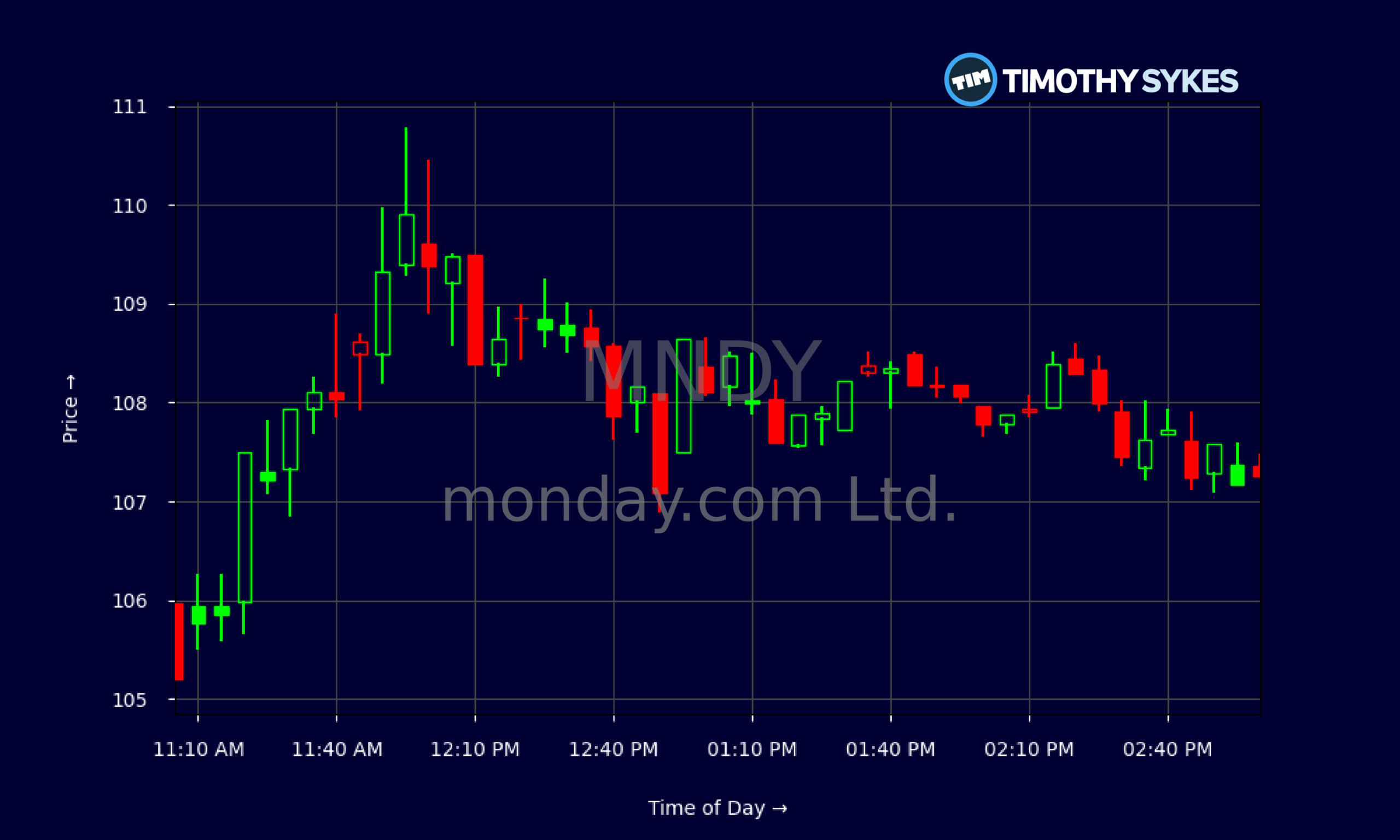
Live Update At 15:02:38 EDT: On Thursday, October 22, 2026 monday.com Ltd. stock [NASDAQ: MNDY] is trending up by 7.1%! Discover the key drivers behind this movement as well as our expert analysis in the detailed breakdown below.
Quick Financial Overview
MNDY has been on a notable run in October. From 2026/09/28 to 2026/10/22, monday.com climbed from a close near $79 to about $107.26, a powerful multi-week uptrend that active traders track closely. Pullbacks along the way, like the dip toward $78.80 on 2026/10/02, have been bought, showing dip demand.
Short-term, the MNDY intraday tape on 2026/10/22 shows steady grinding strength. After opening near $100.23, monday.com pushed as high as $110.77 before consolidating in a tight band around $107–$108 into the close. That kind of range expansion, then controlled consolidation, often signals strong hands in control rather than a blow-off.
More Breaking News
On fundamentals, monday.com posted about $1.23B in revenue over the latest period, trading around 3.1 times sales and roughly 3.06 times book value. MNDY is still not a profit machine, with negative return on assets and equity, but it sits on about $1.66B in cash and short-term investments and more than $1.07B in working capital. For traders, that balance sheet gives MNDY time to execute its AI strategy without immediate financing risk, even as profitability metrics lag growth ambitions.
Why Traders Are Watching MNDY’s Harmony AI Momentum
MNDY is trading like an AI story stock with real products, not just buzz. The big catalyst is Harmony, monday.com’s new voice AI agent platform for enterprise and mid-market sales teams. Built on proprietary task-specific LLMs and OneAI voice tech, and wired into Twilio plus major CRMs, Harmony is designed to handle real sales calls, not just demo scripts.
Early customers are already seeing better conversion metrics, which matters. Traders chase numbers, not narratives. If Harmony lifts win rates for large sales teams, that gives monday.com a clear path to upsell and cross‑sell into higher-value accounts. It also tightens the link between MNDY’s AI story and actual revenue potential.
The market reacted fast. Monday.com gained roughly 2.5% after the Harmony launch, confirming that traders are willing to pay up when the company delivers concrete AI products. This bounce came after a rough patch: Barclays downgraded MNDY from Overweight to Equal Weight, held its $100 target, and warned that core growth is slowing while AI monetization is only about 1% of ARR today. That call knocked the shares down around 4.7%, showing how sensitive MNDY is to growth doubts.
Layer in the Gartner recognition, where monday.com was again named a Leader and ranked highest for both vision and execution, and you get a tug‑of‑war. On one side, third‑party validation and fresh AI launches; on the other, Street concerns that revenue growth and AI dollars still need to catch up to the hype. That tension is exactly what short-term traders look to exploit.
Conclusion
For active traders, MNDY now sits at the crossroads of hype and execution. The stock’s strong October price action, the Harmony launch, and repeated Gartner leadership all tell one story: monday.com has a credible product stack and a serious AI roadmap. The Barclays downgrade and the reminder that AI is only around 1% of ARR tell another: the revenue payoff is still in early innings.
The upcoming Q3 2026 earnings release, plus the New York non-deal roadshow, are the next checkpoints. Traders will listen for hard numbers around Harmony adoption, AI-driven upsell, and whether core growth is stabilizing. With a solid cash position and low leverage, MNDY has room to push its AI-centric workspace strategy, but the market will demand proof that this translates into sustained top-line acceleration.
This setup fits a classic pattern that Tim Sykes and Tim Bohen talk about all the time: “The market doesn’t care about your stories, it cares about your numbers and your discipline.” As millionaire penny stock trader and teacher Tim Sykes says, “Embrace the journey, the ups and downs; each mistake is a lesson to improve your strategy.” For MNDY, that means traders should track the chart, respect volatility around earnings, and watch how Harmony and other AI tools move the revenue needle over the next few quarters. This article is for educational and research purposes only and is not investment advice.
This is stock news, not investment advice. Timothy Sykes News delivers real-time stock market news focused on key catalysts driving short-term price movements. Our content is tailored for active traders and investors seeking to capitalize on rapid price fluctuations, particularly in volatile sectors like penny stocks. Readers come to us for detailed coverage on earnings reports, mergers, FDA approvals, new contracts, and unusual trading volumes that can trigger significant short-term price action. Some users utilize our news to explain sudden stock movements, while others rely on it for diligent research into potential investment opportunities.
Dive deeper into the world of trading with Timothy Sykes, renowned for his expertise in penny stocks. Explore his top picks and discover the strategies that have propelled him to success with these articles:
- Penny Stocks Trading Guide
- Best Penny Stocks Under $1 to Buy Today
- Top 8 Penny Stocks to Watch on Robinhood
Once you’ve got some stocks on watch, elevate your trading game with StocksToTrade the ultimate platform for traders. With specialized tools for swing and day trading, StocksToTrade will guide you through the market’s twists and turns.
Dig into StocksToTrade’s watchlists here:





Leave a reply